
Common signals that the body needs fluid.
WATER · WELLBEING · INEQUALITY
A FAIRER FUTURE
STARTS WITH WATER.
Explore The 3H Effect — Hydration, Hygiene and Housing — through interactive community science for Science Week 2026.
THE 3H EFFECT
Explore. Experiment. Share. Create change.
Water supports every part of life, but access to drinking water, washing facilities and a healthy home is not the same for everyone. Choose a lesson below. You can write, draw, speak, listen or pass.
LESSON 1
Hydration Explorer
Enter the organiser password to unlock all three lessons for the current browser session.
LESSON 2
Hygiene
This lesson is locked. Use the same organiser password to unlock all three 3H lessons for this browser session.
PART TWO · HYGIENE
See how microbes travel.
Hygiene is not simply a personal habit. It depends on water, soap, safe facilities, time, money, privacy, accessibility and freedom from stigma.
Washing experiment
Choose a stage and watch the demonstration material change.
Demonstration material remaining100%
Before washing: demonstration material is visible across the hands.
PHONE
DOOR
FACE
TRANSFER EXPLORER
Hands connect surfaces.
This animation uses coloured particles as a teaching model for transfer. Real microbes are microscopic and are not visible like this.
Ready to demonstrate transfer.
HEALTH CONNECTION
Why hygiene access matters.
Hand hygiene can reduce transmission of infectious agents, especially around food, toileting, coughing, sneezing and caring activities.
Safe washing facilities support cleanliness and skin care; harsh products or excessive washing can also irritate skin.
Privacy, menstrual hygiene, accessible toilets and washing facilities affect comfort, participation and dignity.
When water, soap or facilities are unreliable, avoiding infection is not simply a matter of individual choice.
Explain
Soap helps lift oils and material from the skin. Friction reaches more surfaces. Rinsing carries loosened material away. Drying matters too.
LESSON 3
Housing
This lesson is locked. Use the same organiser password to unlock all three 3H lessons for this browser session.
PART THREE · HOUSING
The damp detective.
Housing conditions can shape breathing, sleep, infection risk, stress and the ability to drink, wash, cook and store belongings safely. Look for clues without assuming the resident caused the problem.
Humidity55%Middle range
Bedroom humidity explorer
LowerMiddleHigher
Water held in the fabric moves into the room air as water vapour.
The amount of water vapour in the indoor air increases.
Moist air meeting a colder surface can form condensation.
Persistently damp conditions can contribute to damp and mould risk.
MOULD & HEALTH
When damp persists, mould can grow.
Mould is a type of fungus. In persistently damp indoor spaces it can grow on walls, ceilings, window surrounds, fabrics and other materials. Mould and dampness are associated with respiratory symptoms, allergies and asthma; damp or mouldy buildings are also associated with respiratory infections and worsening asthma.
Illustrative exposure pathway — not to scale
Exposure in damp or mouldy buildings is associated with more respiratory symptoms, including cough, wheeze and breathing problems.
Mould and damp can trigger or worsen asthma symptoms in susceptible people.
Mould spores can trigger allergic reactions, including allergic rhinitis in people who are sensitive.
People living or working in damp or mouldy buildings have an increased risk of respiratory infections.
Important
This lesson shows health associations and risks; it does not diagnose illness or prove that mould caused an individual person's symptoms. Anyone with persistent or severe breathing symptoms should seek appropriate healthcare. Suspected mould should not be touched or disturbed as part of this workshop activity.
Look beyond the individual
People may have limited drying space, heating, ventilation, money or other safe options. Where available, suitable ventilation and safer drying arrangements can help, but many housing risks require action from landlords, services, building managers or public bodies. Do not touch or disturb suspected mould; concerns should be referred through appropriate professional routes.
EVALUATION · DISCOVER PROGRAMME
What changed?
Share what you knew before the experience, what you learned afterwards, and what stood out to you.
PROTECTED AREA
Evaluation
Enter the organiser password to open the evaluation for the current browser session.
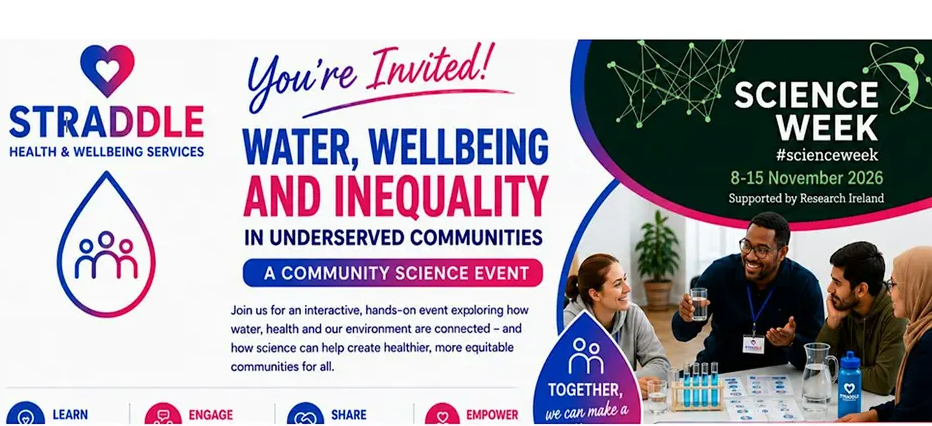
YOU'RE INVITED
Water, Wellbeing and Inequality
A community science event exploring how water, health and our environment are connected — and how science can help create healthier, more equitable communities for all.
JOIN THE MOVEMENT
Register for the event.
Choose either official registration route.